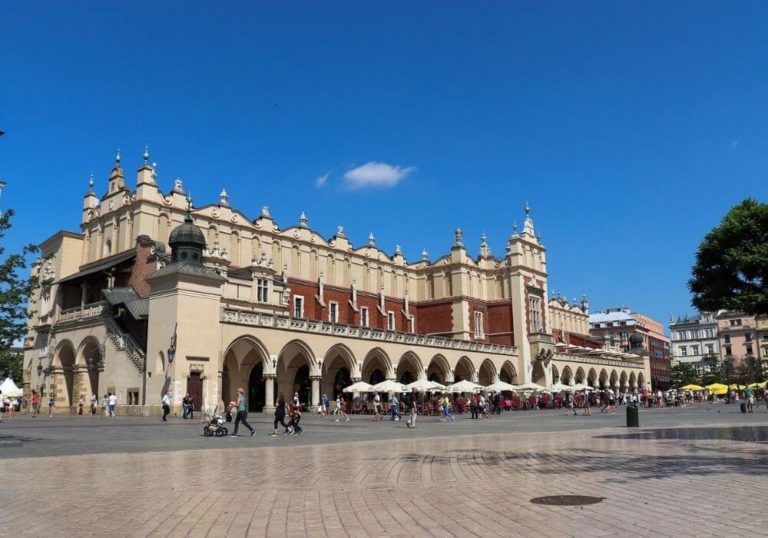
The coats of arms in Kraków’s Cloth Hall — and other Cloth Hall facts
The Cloth Hall (Sukiennice) is one of Kraków’s best-known landmarks — and one of the most interesting if you look up. The walls of its central passage are lined with a gallery of Polish town coats of arms, seals and guild emblems — more than a hundred pieces, one of the largest such collections in Poland. Where did they come from, what happened to them, and what other curiosities does the Cloth Hall hide? Here’s the story.
The coats of arms in the Cloth Hall
The coats of arms weren’t there from the start. They appeared only in 1895, some years after the neo-Gothic rebuilding of the Cloth Hall. The original set had around 36–37 coats of arms of towns from all three partitions — Polish lands and towns historically linked with Poland, including Vilnius, Grodno, Kyiv, Lviv, Wrocław, Cieszyn, Gdańsk, Toruń and Riga.
The gallery survived World War II — the coat of arms of Lviv was still in place in 1940. Changes came only in 1948, when the arms of towns left outside Poland’s new borders were removed, including Grodno, Kamianets-Podilskyi, Kyiv, Riga and Lviv. Over time the set was extended with more coats of arms, seals and the guild emblems of Kraków, Kazimierz and Kleparz. The most recent addition, the coat of arms of Częstochowa, came in 2006.
A short history of the Cloth Hall
The history of the Cloth Hall goes back to Kraków’s charter of 1257, when the duke undertook to build stone cloth stalls in two rows in the middle of the market square; around 1300 the passage between them was roofed. Under Casimir the Great a Gothic hall 108 m long was built, with 36 stalls — 18 in each row. After a fire in 1555 the building was given its Renaissance form, with an attic decorated with grotesque masks, and in 1875–1879 it was remodelled to a design by Tomasz Pryliński, which added the neo-Gothic arcades.
Cloth Hall fun facts
- The first national museum. In 1879 the first seat of the National Museum in Kraków opened upstairs in the Cloth Hall. Item number one in its inventory was “Nero’s Torches”, a gift from the painter Henryk Siemiradzki. Today the upper floor houses the Gallery of 19th-Century Polish Art.
- Mayors in stone. Some of the masks on the eastern side of the attic bear the faces of Kraków’s mayors Józef Dietl and Mikołaj Zyblikiewicz, carved by Walery Gadomski to a design by Jan Matejko.
- A knife on a chain. A knife hangs in the passage — an old symbol of Magdeburg law and a reminder that thieves had their ears cut off. Legend links it to the brothers who built the towers of St Mary’s Basilica.
- Gas lamps. Gas lamps still light the Cloth Hall arcades.
- Rynek Underground. The entrance to Rynek Underground — a Museum of Kraków route opened in 2010 beneath the Main Square — is from the Cloth Hall.
Where to stay in Kraków
The closest base for the Cloth Hall is Best Western Plus Kraków Old Town at Świętej Gertrudy 6 — about 500 m from the Main Square and about 600 m from the Cloth Hall itself. A characterful alternative is Hotel Regent in a historic townhouse in Kazimierz, about 15 minutes’ walk from the Main Square.
Frequently asked questions
How many coats of arms are there in the Cloth Hall?
The collection of town coats of arms, seals and guild emblems in the Cloth Hall passage has more than a hundred pieces. The most recent coat of arms, Częstochowa’s, was added in 2006.
When were the coats of arms added?
In 1895. In 1948 the arms of towns left outside Poland’s borders, including Lviv and Kyiv, were removed.
What’s upstairs in the Cloth Hall?
The Gallery of 19th-Century Polish Art — part of the National Museum in Kraków, whose first seat was here, from 1879.
Updated in October 2026.