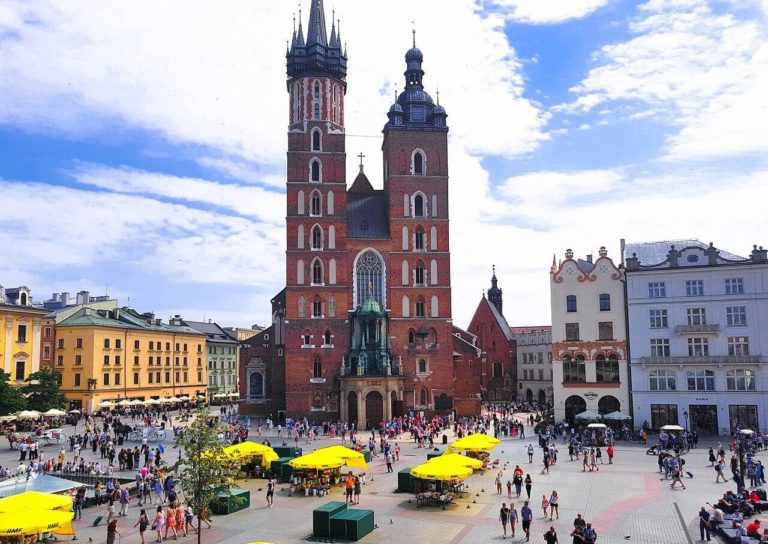
St Mary’s Basilica in Kraków — secrets and fun facts you didn’t know
St Mary’s Basilica in Kraków is one of Poland’s most recognisable churches. It has stood on the Main Square for around 800 years and witnessed many historic events. Almost everyone knows the trumpet call, the two mismatched towers and Veit Stoss’s altarpiece — but the church also has secrets that even many locals don’t know. Here are some lesser-known facts about the basilica and practical tips for visiting in 2026.
When the vault collapsed
According to the chronicler Jan Długosz, the first brick church on this site was founded by Bishop Iwo Odrowąż in 1221–1222; the present Gothic building took shape from the late 13th century and through the 14th. In 1442 the vault over the chancel collapsed, destroying the old high altar. Tradition links the collapse to an earthquake. The new vault was built by master Czipser of Kazimierz.
A dispute over German sermons
Many German burghers lived in medieval Kraków, and St Mary’s was the church of the city’s patrician elite — for a long time it was run by the German community. In the early 16th century Polish councillors pushed for the parish to become Polish. The dispute was settled in 1537 by King Sigismund the Old: at the request of the nobility’s envoys, Polish sermons moved to St Mary’s and German ones to the neighbouring St Barbara’s Church.
The Chapel of the Condemned
St Mary’s has 11 chapels. A particular story is attached to St Anthony’s Chapel on the north side. It was once dedicated to St Stanislaus and the Last Judgement and was known as the Chapel of the Condemned — prisoners sentenced to death were prepared here before being led to their execution in the morning.
The kuna: an iron collar for sinners
By the entrance from St Mary’s Square hangs an iron ring called the kuna. It was fastened around the necks of penitents so that they could neither stand up straight nor kneel. Today it hangs oddly low — because over the centuries the pavement level has risen.
Why the towers are different
The taller tower, the Hejnalica, is about 82 m high; the lower bell tower is 69 m. Legend says they were built by two brothers, and the elder, jealous of his younger brother’s more beautiful tower, killed him with a knife — the very knife that still hangs in the Cloth Hall. Historians see the knife rather as a symbol of Magdeburg law and a reminder of the punishments for thieves.
The hejnał and the legend of the Tatar arrow
The hejnał trumpet call is played from the Hejnalica every hour by firefighters, in all four directions, and since 1927 Polish Radio has broadcast it at noon. The melody breaks off mid-phrase — according to legend, in memory of a trumpeter struck by a Tatar arrow in 1241. Interestingly, the story was first written down by the American author Eric P. Kelly in his 1928 novel “The Trumpeter of Krakow”; no earlier records are known.
Veit Stoss’s altarpiece: from Kraków to Nuremberg and back
The high altar is about 13 m tall and 11 m wide, with more than 200 figures, the largest about 2.8 m high. In 1939, fearing war, the figures were dismantled and shipped down the Vistula to Sandomierz. The Germans forced the hiding place to be revealed and took the altarpiece to the Reich — the sculptures ended up in the vaults beneath Nuremberg Castle, in the city where Veit Stoss lived and worked for most of his life, and part of the structure at Wiesenthau Castle.
After the war the altarpiece was tracked down by Professor Karol Estreicher with American help. It returned to Kraków in spring 1946, conservation at Wawel lasted until 1950, and it went back to its place in the church in 1957. Some other works looted from the church were never recovered.
Visiting St Mary’s Basilica (2026)
- Basilica: Monday to Saturday 11:30–18:00, Sundays and holidays 14:00–18:00. Sightseeing requires a ticket, sold at 7 Plac Mariacki. Visitors use the south entrance — the main entrance from the Main Square is reserved for worshippers.
- Altarpiece opening: Monday to Saturday at 11:50, Sundays and holidays at 14:10.
- Hejnalica tower: open seasonally, from April to the end of October. Entry every 30 minutes in groups of up to 15, with a timed ticket from the ticket office at 7 Plac Mariacki; children from age 7.
Check current opening hours and ticket prices on the basilica’s website mariacki.com.
Where to stay in Kraków
The closest base for St Mary’s is Best Western Plus Kraków Old Town at Świętej Gertrudy 6 — about 500 m from the Main Square, so the noon trumpet call is just a few minutes’ walk away. A characterful alternative is Hotel Regent in a historic townhouse in Kazimierz, about 15 minutes’ walk from the Main Square.
Frequently asked questions
What time does the altarpiece open at St Mary’s?
Monday to Saturday at 11:50, and on Sundays and holidays at 14:10.
Can you climb the tower of St Mary’s Basilica?
Yes, the Hejnalica — from April to the end of October, in groups of up to 15, with a timed ticket. From November to March the tower is closed.
Are masses held at St Mary’s Basilica?
Yes, it’s an active parish church. Worshippers enter through the main door from the Main Square; mass times are listed on the parish website.
Updated in October 2026.