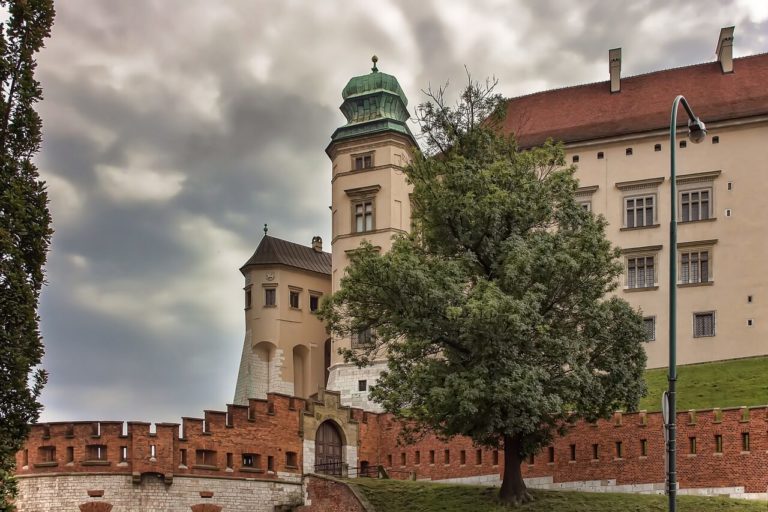
The curse of Casimir IV Jagiellon — what happened after the Wawel tomb was opened
The “curse of Casimir IV Jagiellon” is the name given to a series of sudden deaths among the people who opened and studied the king’s tomb in Wawel Cathedral in 1973. According to Zbigniew Święch, author of a book on curses and microbes, 15 of them died within ten years, mostly of heart attacks and strokes. Scientists pointed to a possible culprit — the fungus Aspergillus flavus — although conclusive proof was never found. Here is the story.
A tomb sealed for almost 500 years
Casimir IV Jagiellon, the youngest son of Władysław Jagiełło, died in Grodno on 7 June 1492; his body was brought to Kraków and buried in July. His tomb monument in the Holy Cross Chapel of Wawel Cathedral was carved in red marble by Veit Stoss in 1492–1496 — a late Gothic masterpiece, with the master’s signature beneath the king’s feet. The body itself lies below, in the burial chamber.
Opening the tomb in 1973
During conservation work in the Holy Cross Chapel it was decided to examine the burial chamber. In May 1973, with the consent of Cardinal Karol Wojtyła, a team of 12 opened the tomb. A year earlier, during the same work, the tomb of the king’s wife, Elisabeth of Austria, had been opened. Samples were taken, and in autumn 1973 the royal couple were reburied.
A series of sudden deaths
Less than a year later the deaths began. Feliks Dańczak died in April 1974, Stefan Walczy in June, Kazimierz Hurlak in August and Jan Myrlak in May 1975 — all had worked on the tomb. Zbigniew Święch counted 15 deaths within ten years among those involved, most of them sudden, from heart attacks or strokes. Other sources speak of 10 of the 12 team members. The “curse” became widely known especially after Cardinal Wojtyła was elected pope in 1978.
Curse or fungus?
In samples from the tomb, microbiologist Professor Bolesław Smyk identified the fungus Aspergillus flavus. It produces aflatoxins — highly toxic, carcinogenic compounds that damage the liver, among other organs. The hypothesis is that the researchers inhaled spores that had survived in the sealed chamber. It remains only a hypothesis: the deceased were not autopsied for this, and there is no pathological evidence.
Other post-war openings of royal tombs at Wawel — including Queen Jadwiga’s in 1949 and General Sikorski’s in 2008 — passed without incident.
Where to stay in Kraków
You can see Casimir IV Jagiellon’s tomb when you visit Wawel Cathedral. A convenient base is Best Western Plus Kraków Old Town at Świętej Gertrudy 6, right by the Planty park, from where you can walk the Royal Route to Wawel. A characterful alternative is Hotel Regent in Kazimierz.
Frequently asked questions
What was the curse of Casimir IV Jagiellon?
After the king’s tomb was opened in 1973, many people who had worked on it died suddenly — according to Zbigniew Święch, 15 within ten years.
What explains the curse?
The usual explanation is the fungus Aspergillus flavus found in samples from the tomb, which produces toxic aflatoxins. It’s a hypothesis without conclusive proof.
Where is Casimir IV Jagiellon’s tomb?
In the Holy Cross Chapel of Wawel Cathedral; the tomb monument was carved by Veit Stoss in 1492–1496.
Updated in October 2026.