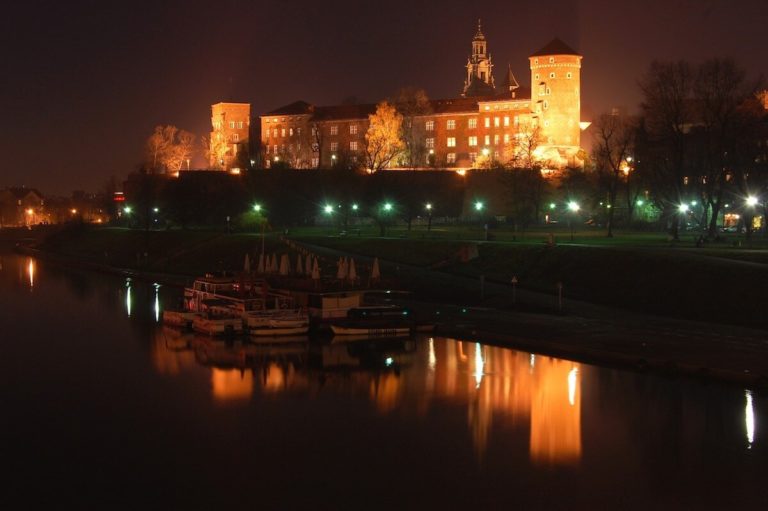
Fires at Wawel — when the royal residence suffered most
The greatest fires at Wawel broke out in 1305, 1499, 1536, 1595 and 1702. The worst was the last: in 1702, during the Great Northern War, fires lit by Swedish soldiers directly on the floors destroyed most of the castle. Legend links the 1595 fire to the alchemist Michael Sendivogius. Here is the story of fire on the royal hill.
The Middle Ages: a wooden castle and a cathedral in flames
The first great fire of Kraków recorded in the annals broke out in 1125 and delayed the building of the cathedral. The fire of 1305 was catastrophic: flames from the burning town spread to the cathedral — according to records, the day after St Stanislaus’s feast, i.e. 9 May (some historians date it to 1306). The wooden castle burned down too. Wawel only became less vulnerable to fire under Casimir the Great, who built a brick palace. The new Gothic cathedral was consecrated on 28 March 1364.
1499 and 1536: fires in the Jagiellonian castle
In 1499, as the chronicler Marcin Bielski wrote, “fire at the castle burned the Hen’s Foot”. The damage wasn’t very serious, but the repairs launched the castle’s Renaissance rebuilding. On the night of 17–18 October 1536, while Sigismund the Old was in Lithuania, a fire broke out in a small room next to the king’s bedchamber and spread to the upper royal rooms and the Lubranka Tower — the east wing was damaged. According to Bielski, many of those fighting the fire died when the vaults of the galleries collapsed on them.
1595: the fire legend blames on Sendivogius
In 1595 the castle burned twice — on 25 January and 9 June. The second fire destroyed the roofs and top floors of the north wing, from the Hen’s Foot to the cathedral. Legend says it was caused by a failed experiment by the alchemist Michael Sendivogius, who by tradition had his workshop in the Hen’s Foot tower — but there’s no evidence. Sigismund III Vasa rebuilt the castle in 1596–1609 in early Baroque style, and Giovanni Trevano added two towers to the north wing. The king gradually moved to Warsaw, however, settling there for good in 1606. He returned to Wawel after death — he was buried in the cathedral.
1702: the worst disaster in the castle’s history
During the Great Northern War, in the reign of Augustus II, the troops of Sweden’s King Charles XII occupied Kraków and the castle. The soldiers heated the chambers with fires lit directly on the floors. In September 1702 one got out of control and burned for days. The roofs and most rooms of the north wing down to the ground floor were destroyed, along with most of the east wing. The cathedral survived, although the Swedes ransacked it.
Repairs were carried out in 1716–1730, and under Stanisław August Poniatowski the Sejm passed a resolution in 1768 to rebuild the castle — in 1787 the architect Domenico Merlini worked here. Full restoration, however, came only in the 20th century.
Where to stay in Kraków
Wawel is an easy walk from Best Western Plus Kraków Old Town at Świętej Gertrudy 6 — right by the Planty park, about 500 m from the Main Square. A characterful alternative is Hotel Regent in Kazimierz, about 15 minutes’ walk from Wawel.
Frequently asked questions
When were the biggest fires at Wawel?
In 1305, 1499, 1536, 1595 and 1702. The most destructive was the 1702 fire, caused by Swedish soldiers’ campfires.
What burned at Wawel in 1595?
The roofs and upper rooms of the castle’s north wing. Sigismund III Vasa rebuilt them in 1596–1609 in early Baroque style.
Did Sendivogius cause the Wawel fire?
So the legend says, but there’s no evidence. Tradition only holds that the alchemist had a workshop in the Hen’s Foot tower.
Updated in October 2026.