Kraków dialect — “na pole”, “idźże” and other local words
The Kraków dialect isn’t very different from standard Polish, but on the streets of Kraków you’ll hear words and phrases that immediately give away where you are. The most famous are “na pole” and the “-że” ending in “idźże” or “chodźże”. We’ve collected the ones worth knowing on a visit — all of them appear in the dictionary “Powiedziane po krakowsku” (“Said the Kraków way”), published by linguists at the Jagiellonian University.
“Na pole” or “na dwór”?
Nothing in the local speech is as famous as “pole”. Standard Polish says “na dwór” for “outside” — literally “to the courtyard” — but in Kraków and the surrounding Małopolska region people say “na pole” (literally “to the field”). “Jak jest na polu?” (“How is it out in the field?”) simply means “What’s the weather like?”, and “idziemy na pole” means “let’s go outside”.
The “pole vs dwór” debate is a long-running joke between Kraków and the rest of Poland. Linguists explain that “na dwór” became the standard form mainly because of Warsaw’s greater influence — so “na pole” isn’t a mistake, just a regional expression.

Idźże, chodźże, weźże — the Kraków “-że”
Adding “-że” to verbs in the imperative is a Kraków trademark. It makes a request or command more emphatic: “chodźże na pole!” (“come on outside!”) is an invitation for a walk, “weźże to zrób” is a nudge to get something done, and “zróbże coś” (“do something, will you”) shows impatience.
A classic is “idźże, idźże, ty bajoku!” (or “idze, idze, bajoku!”), which a Kraków local might say to a story they don’t believe — roughly “oh, get away with you!”. According to the dictionary, a bajok is a frivolous person who likes to make things up, talk nonsense and spread gossip.
Getting ready for a walk
Before you head out “na pole”, in Kraków you ubierać (“dress”) your hat, jacket or shoes rather than “put them on” (standard “zakładać”). On your head you might wear a beretka — the local word for a beret. And try not to spaźniać się — the Kraków version of “to be late”.
Kraków on a plate

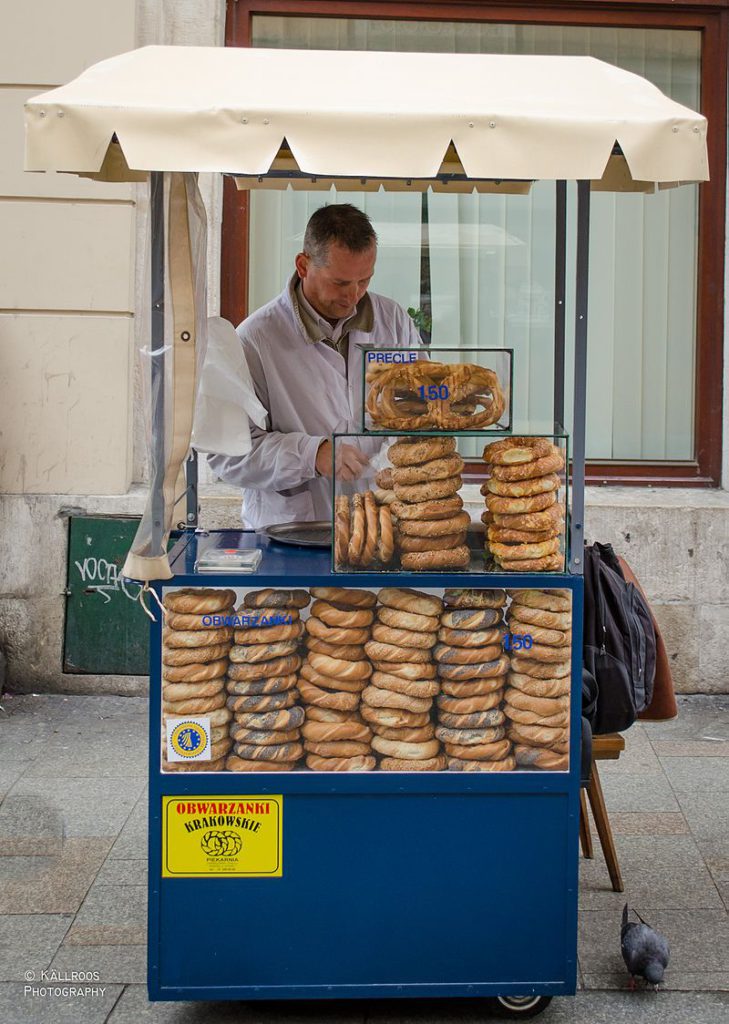
On a walk around the Main Square you can buy an obwarzanek — a ring-shaped bread with poppy seeds, sesame or salt, similar to a bagel — on almost every corner. In a bakery you might ask for a weka (a large, long wheat roll) or a bośniak (a roll with lots of caraway seeds). In Kraków a sznycel is a minced-meat cutlet, not a schnitzel.
In a traditional café you’ll find cwibak (a fruitcake packed with dried fruit and nuts), chrust (crispy fried pastry known elsewhere in Poland as faworki), andruty (wafers) and piszinger — layers of wafers with chocolate filling, named after the confectioner Oskar Pischinger. And if a cake has borówki in it, in Kraków that means bilberries.
Words from a Kraków home
- nakastlik — bedside table,
- sagan, saganek — kettle,
- bańka — Christmas tree bauble,
- zastrugaczka — pencil sharpener,
- krachla — a swing-top bottle,
- cumel — a baby’s dummy (pacifier).
Where to stay in Kraków
You’ll hear the most “idźże” and “na polu” staying right in the centre. Best Western Plus Kraków Old Town at Świętej Gertrudy 6 is about 500 m from the Main Square, and Hotel Regent is in a historic townhouse in Kazimierz, about 15 minutes’ walk from the Main Square.
Frequently asked questions
What does “idźże” mean?
It’s “idź” (“go”) with the emphatic Kraków ending “-że”. The phrase “idźże, idźże, ty bajoku!” expresses disbelief — something like “oh, stop making things up!”.
Why do people in Kraków say “na pole”?
In the Kraków and Małopolska dialect, “pole” means the open air, outdoors. The standard form “na dwór” spread mainly under Warsaw’s influence; “na pole” is a correct regional expression.
What is piszinger?
A Kraków dessert made of layers of wafers with chocolate filling, named after the confectioner Oskar Pischinger.
Updated in October 2026.