The Lajkonik — Kraków’s legendary rider, its history and procession
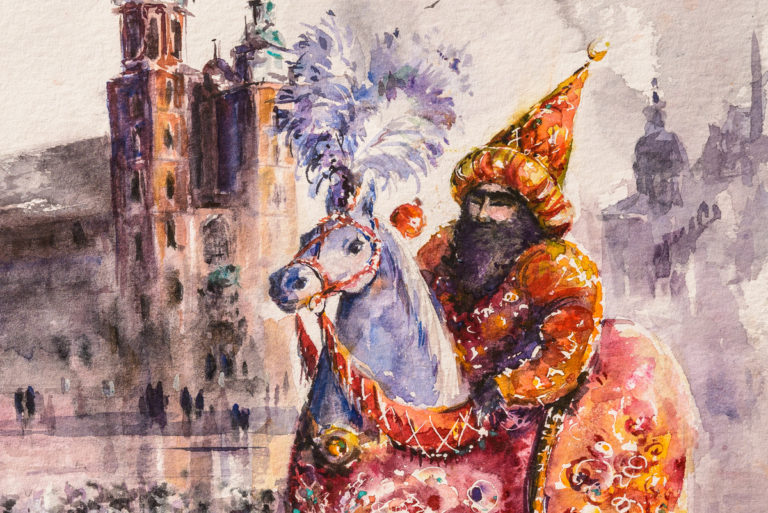
The Lajkonik is a rider in Tatar costume on a wooden hobby horse who parades through the streets of Kraków once a year. The procession takes place on the first Thursday after Corpus Christi — in 2027, scheduled for 3 June — and is one of Kraków’s most colourful traditions, added in 2014 to Poland’s national list of intangible cultural heritage. Where does it come from, and what does a tap of his mace mean? Here’s the story.
The legend of the Lajkonik
According to legend, in the 13th century — 1287 is the year most often given — Tatar raiders approached Kraków. They camped at Zwierzyniec, then a village outside the city, planning to attack in the morning. Their plans were foiled by the włóczkowie, Kraków’s raftsmen: at night they raided the camp, defeated the Tatars, dressed in their clothes and rode into the city on the captured horses. The townspeople were terrified at first, but soon realised these weren’t invaders but the victorious raftsmen.
What really happened?
Historians don’t know whether the legend explains the custom or the custom gave rise to the legend. The earliest written account of the Tatar legend dates only from 1820. The custom itself is older: in 1700 the records of the Norbertine convent mention that after the Corpus Christi procession the raftsmen “played in the courtyard as usual”, and the first mention of the hobby horse’s antics comes from 1738. Scholars link the celebration to the raftsmen’s guild festival, older folk rites or religious pageants.
The Lajkonik procession — when and where?
The procession is held every year during the octave of Corpus Christi, on the first Thursday after the feast. In 2027 that’s 3 June — details are announced by the Museum of Kraków, which has organised the procession since 1947.
The parade sets off around noon from the Kraków Waterworks building on Senatorska Street and passes Plac Na Stawach and the courtyard of the Norbertine convent, Kościuszki Street, the boulevards and Zwierzyniecka Street, past the Philharmonic, along Franciszkańska Street and across Plac Wszystkich Świętych to the Main Square. The Lajkonik is accompanied by raftsmen and a band. Along the way the procession collects “tribute” from shops and restaurants, and the Lajkonik dances and taps passers-by with his mace — a tap is said to bring luck for the whole year. On the Main Square the mayor hands over the tribute, followed by a toast and a dance. The procession lasts from midday until the evening.
Wyspiański’s costume
Today’s Lajkonik costume was designed in the early 20th century, partly by the artist Stanisław Wyspiański. The original, used in processions until 2015, belongs to the Museum of Kraków — today the Lajkonik wears a faithful copy. You can see the costume in the permanent exhibition “Kraków from the beginning, without end” in Krzysztofory Palace on the Main Square.
The Lajkonik as a brand
The Lajkonik appears on magnets, souvenirs and company logos. The best known are Lajkonik Snacks, a maker of pretzel sticks and snacks from Skawina near Kraków (the factory has existed since 1910 and has made pretzel sticks since 1970), and the independent Lajkonik bakery and café chain, founded in Kraków in 2012.
Where to stay in Kraków
The Lajkonik procession is worth a few days’ stay. Best Western Plus Kraków Old Town at Świętej Gertrudy 6 is about 500 m from the Main Square, where the procession ends. A characterful alternative is Hotel Regent in a historic townhouse in Kazimierz.
Frequently asked questions
When is the Lajkonik procession in 2027?
It’s scheduled for Thursday 3 June 2027 — the first Thursday after Corpus Christi. Details are announced by the Museum of Kraków.
What is the Lajkonik?
A rider in Tatar costume on a wooden hobby horse and a symbol of Kraków. According to legend, it commemorates the victory of Kraków’s raftsmen over the Tatars in the 13th century.
Does a tap from the Lajkonik’s mace bring luck?
Yes — according to tradition, being tapped with the Lajkonik’s mace brings good luck for the whole year.
Updated in October 2026.